Gross Motor vs Fine Motor Skills: A Parent’s Guide
Written by the Inclusive Developmental and Therapy Center therapy team — our Speech & Language Therapist, psychology and ABA staff. Clinical reviewer for this site: Dr Muhammad Suffyan, MB BS (GMC 8023727) · Updated August 2026; this page has changed since our last clinical review.
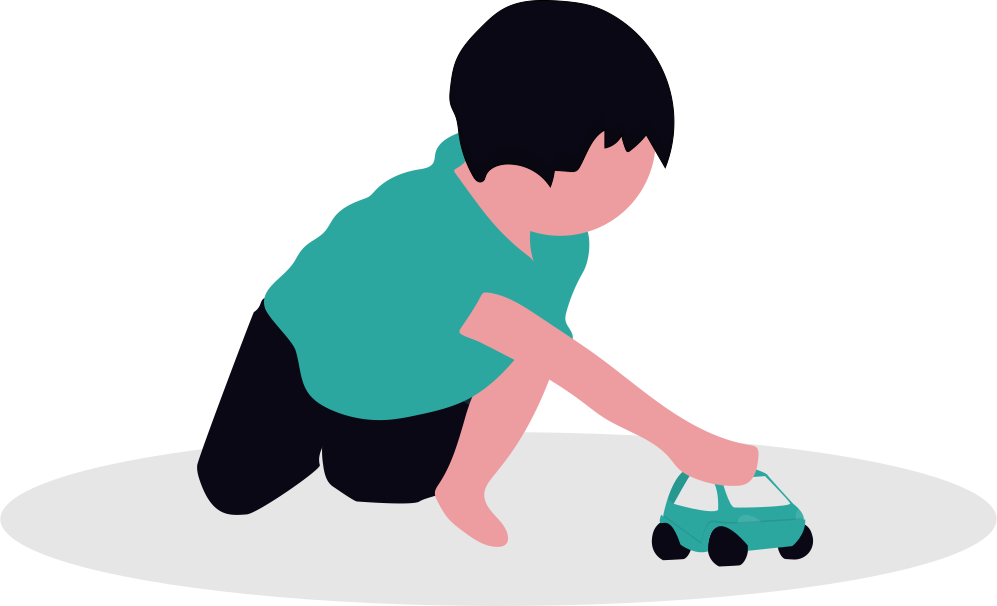
Gross motor skills vs fine motor skills: gross motor is the big, whole-body movements — sitting, walking, running, climbing, throwing. Fine motor is the small, precise hand movements — a pincer grip, a spoon, a button, a pencil. The same difference is searched as fine vs gross motor, gross and fine skills, and motor skills fine and gross. Your child is building both at once, mostly through ordinary play, and the big movements usually lead the way.
Most parents meet these two phrases the same way: in a nursery report, or on the way out of a doctor’s room, with no one stopping to explain them. So here is the plain version. If you are trying to choose between a physiotherapist and an occupational therapist, use physio or occupational therapy — walking and tone versus hands and daily life.
- Gross motor means the big muscles — legs, arms and trunk. They carry your child around their world and hold them steady in it.
- Fine motor means the small muscles — the hands and fingers, guided by the eyes. They let your child handle and shape the things in that world.
- The two are linked. A steady trunk and strong shoulders come first; pencil control is built on top of them.
- One late skill rarely means much. A pattern across several skills, or a skill your child has lost, is what deserves a developmental assessment.
What are gross motor skills?
Gross motor skills are movements that use the large muscles of the legs, arms and trunk. They cover rolling, sitting, crawling, walking, running, jumping, climbing, throwing and catching. They also cover the quieter job of holding the body upright and steady — which is what lets a child sit at a table without wobbling.
Everyday examples of gross motor skills:
- Rolling over, sitting up and crawling in the early months.
- Pulling to stand, cruising along the furniture, and those first wobbly steps.
- Walking, running and climbing the stairs as a toddler.
- Jumping with two feet, hopping on one, and kicking a ball.
- Throwing and catching, balancing on a low wall, riding a tricycle.
- Later on, skipping, swimming, and keeping up in a game of tag.
What are fine motor skills?
Fine motor skills are the small, controlled movements of the hands and fingers, guided by the eyes and supported by the wrist and forearm. They cover picking up a crumb, stacking blocks, using a spoon, turning a page, doing up a button, holding a crayon and cutting with scissors.
Everyday examples of fine motor skills:
- Grasping a rattle, then learning to let go of it on purpose.
- Picking up small objects with finger and thumb in a neat pincer grip.
- Stacking blocks, posting shapes, and turning the pages of a book.
- Using a spoon, then a fork, and drinking from an open cup.
- Scribbling, then drawing shapes, then forming letters.
- Doing up buttons and zips, threading beads, and using scissors.
What is the difference between gross and fine motor skills?
The difference is size and precision. Gross motor skills use the large muscles to move the whole body through space — running across a courtyard. Fine motor skills use the small hand muscles to do a careful job in one spot — threading a bead at the end of that run. Gross motor skills usually develop first and give fine motor skills a steady base to work from.
At school the split is easy to spot: gross motor powers PE, playtime and sitting still at a desk, while fine motor powers handwriting, cutting, and getting changed after sport.
Why does handwriting trouble sometimes start in the shoulders?
Because control develops from the centre of the body outwards. Your child steadies the trunk before the shoulder, the shoulder before the elbow, the elbow before the wrist, and the wrist before the fingers can move on their own. A child with a wobbly trunk is spending their effort staying upright, so there is little left over for the pencil.
This is the part parents are rarely told, and it changes what you do about it. When a child’s writing is messy, more writing practice is often the least useful answer. Crawling games, wall and floor play, carrying and pushing heavy things — all of that gross motor work is handwriting work too. Our guide to pre-writing skills before the pencil shows how that sequence runs in practice. It is also why our team looks at the whole body in a session, not only at the hand holding the crayon.
What is typical at each age?
Children are not machines, and development is not a train timetable. The ages below are broad averages, not deadlines. Plenty of healthy children arrive a good bit earlier or later, and one late milestone on its own rarely means much. Use this as a loose map, not a scorecard.
| Around this age | Gross motor | Fine motor |
|---|---|---|
| 9 months | Sits steadily without support; may start to crawl or shuffle | Moves a toy from one hand to the other; picks up small pieces of food with a raking grip |
| 12 months | Pulls to stand and may cruise along the furniture | Picks up small objects with finger and thumb; bangs two objects together |
| 18 months | Walks on their own | Scribbles with a crayon; drinks from a cup and tries a spoon |
| 2 years | Runs and kicks a ball; walks up and down stairs with help | Builds a small tower of blocks |
| 3 years | Jumps, climbs and pedals a tricycle | Draws a circle and holds a crayon well; feeds themselves with a spoon |
| 4 years | Hops, stands on one foot briefly, and catches a ball | Uses scissors; draws a person with two to four body parts; manages most dressing |
| 5 years | Skips, hops and balances well | Holds a pencil and writes some letters or their name; dresses independently |
Notice how the two columns feed each other. The child who spent a year climbing and hanging is the child whose shoulders are ready for a pencil at four. If you want the fuller picture for your child’s age, our guides to the signs worth checking at two and at three years old set out what we would want to look at, across movement, speech and play together.
Which activities build gross motor skills at home?
Children build gross motor skills through exactly the kind of play they love anyway. You do not need equipment — only floor space, ten minutes, and a bit of encouragement. Praise the effort, not the result.
- Build an obstacle course: cushions to climb over, chairs to crawl under, a line of tape to balance along.
- Throw and catch with a soft ball or a rolled-up pair of socks, moving closer or further apart to change the challenge.
- Put music on and dance, freeze, and dance again — good for balance and body awareness.
- Blow bubbles for your child to chase, stamp on and reach up for.
- Encourage climbing at the park, hopping like a frog, and stomping like an elephant.
- Give real jobs that use the whole body: carrying the laundry basket, pushing a trolley, watering plants.
If you would like this laid out as a week-by-week plan, our movement and coordination home program turns the same ideas into a short daily routine you can follow.
اردو · Urdu: بچے کے جسمانی توازن اور ہاتھ پاؤں کے تال میل کو مضبوط بنانے میں مدد دیں — روزانہ کھلی جگہ پر دوڑنے اور اُچھلنے کا موقع دیں۔
Which activities build fine motor skills at home?
Fine motor practice hides beautifully inside ordinary play and everyday chores. The aim is lots of small chances for careful hand movements. No worksheets required.
- Playdough is the best all-rounder: rolling, squishing and pinching all build hand strength.
- Thread pasta or large beads onto a shoelace, or post coins into a money box.
- Offer tongs or a clothes peg to pick up cotton balls and drop them into a cup.
- Let your child help in the kitchen — tearing leaves, stirring, spreading butter, peeling a boiled egg.
- Draw, colour and stick things down; tear paper before you ever ask for cutting.
- Above all, let your child do their own small self-care jobs — buttons, zips, feeding. Independence is fine motor practice in disguise.
Our hands and handwriting home program sets these out in order, from hand strength through to pre-writing shapes, so you are not guessing at what to try next.
When should I worry about my child’s motor skills?
Ask for advice if your child is much clumsier than other children the same age, tires very quickly during physical play, avoids drawing and fiddly tasks, cannot manage self-care such as dressing when others their age can, or is behind on physical milestones across the board. A skill your child once had and appears to have lost always deserves a look.
The signs we would want to hear about:
- Clumsiness that shows up most days and across several different tasks, not just now and then.
- Tires far more quickly than other children during running, climbing or PE.
- Strongly avoids drawing, cutting, puzzles or anything that needs careful hands.
- Feels unusually floppy, or unusually stiff, when you lift or dress them.
- Uses one hand or one side of the body far more than the other while still a baby.
- Is behind on several milestones at once, rather than one.
- Has lost a movement or hand skill they used to have.
None of these is a diagnosis, and most children with one of them turn out to be fine. But persistent clumsiness across many everyday tasks does have a name — dyspraxia, or Developmental Coordination Disorder. Our page on dyspraxia and DCD describes what it looks like from toddlerhood through to school, if that is the pattern you recognise.
Which professional helps with motor skills?
Motor skills are the main work of an occupational therapist. Physiotherapists focus on the big movements themselves — strength, walking, posture. Occupational therapists focus on using those movements for everyday jobs: dressing, eating, writing, playing. Where sensory difficulties are part of the picture, that sits with an occupational therapist too.
We would rather be straight with you about who does that work here. Our centre does not employ a licensed occupational therapist. What our special education and behavioural therapy team runs is structured skill-building — pencil grip, coordination, dressing, feeding, staying settled — taught step by step through play. Where a child needs formal sensory integration therapy, a clinical hand assessment or a medical opinion, we say so and point you to the right person, even though it means sending you out of our door. You can read exactly what we do and do not offer on our motor and daily skills support page.
Either way, the first step is the same. A developmental assessment maps your child’s strengths as well as their difficulties, because a delay in one area is so often balanced by a real strength in another, and because the plan should follow the child rather than the label. Where noise, textures or movement are part of what is going on, our work on sensory processing difficulties feeds into the same plan.
If how your child moves, grips or coordinates is worrying you, please do not sit with it alone. We work with families across Multan and South Punjab, and with parents further afield through online guidance. Get in touch and we will help you work out what is typical, what is not, and what to do next — warmly, and without judgement.
If you want to record where your own child sits across both, our printable motor skills observation checklist is split into exactly these two halves.
If your child is clearly behind on both halves and it is affecting school, read the clumsy child and developmental coordination disorder — it affects 5 to 6% of school-age children and is rarely named.
Frequently asked questions
My child can run and climb but cannot hold a pencil properly. Is that normal?
Very often, yes. Gross motor and fine motor skills grow at their own pace, so an uneven profile is common and rarely a problem on its own. Strong runners who avoid the pencil usually need more hand work, not more writing — dough, pegs, threading and tearing paper. If the gap is still wide by school age, or your child is distressed by it, ask for an assessment.
Do gross motor skills always develop before fine motor skills?
Broadly, yes. Control develops from the centre of the body outwards, so a child steadies the trunk, then the shoulder, then the elbow and wrist, and only then can the fingers work on their own. That is why a wobbly sitter struggles with a crayon. It is a general pattern, though, not a rule — the two overlap constantly in real children.
How is an occupational therapist different from a physiotherapist?
A physiotherapist works mainly on the big movements themselves — strength, balance, posture, walking. An occupational therapist works on using those movements for daily life: dressing, eating, handwriting, playing, coping with busy places. A very clumsy child may see both. Our centre does not employ a licensed occupational therapist, so where formal therapy is needed we tell you and point you to the right person.
Will my child simply grow out of being clumsy?
Many children do. Coordination improves a great deal between three and six as children get more practice. What does not usually fade on its own is clumsiness that shows up most days, across several kinds of task, and gets in the way of ordinary things like dressing, eating or writing. That pattern is worth having looked at rather than waited out.
Can therapy help my child’s handwriting and pencil grip?
Usually, yes — but the work often starts away from the page. We look at sitting balance, shoulder and arm control, hand strength and how the eyes guide the hand, then build the weakest layer first. Children who have been drilled on letters for months frequently make faster progress once the underlying strength and control are there.
Do you give parents something to follow at home?
Yes. Alongside sessions we set home practice that fits your routine rather than adding another hour to your day, and our gross-motor and fine-motor home programs lay out a short daily plan you can start today without any equipment. Ten focused minutes most days beats an hour once a week, and parents doing the practice is what makes skills stick.